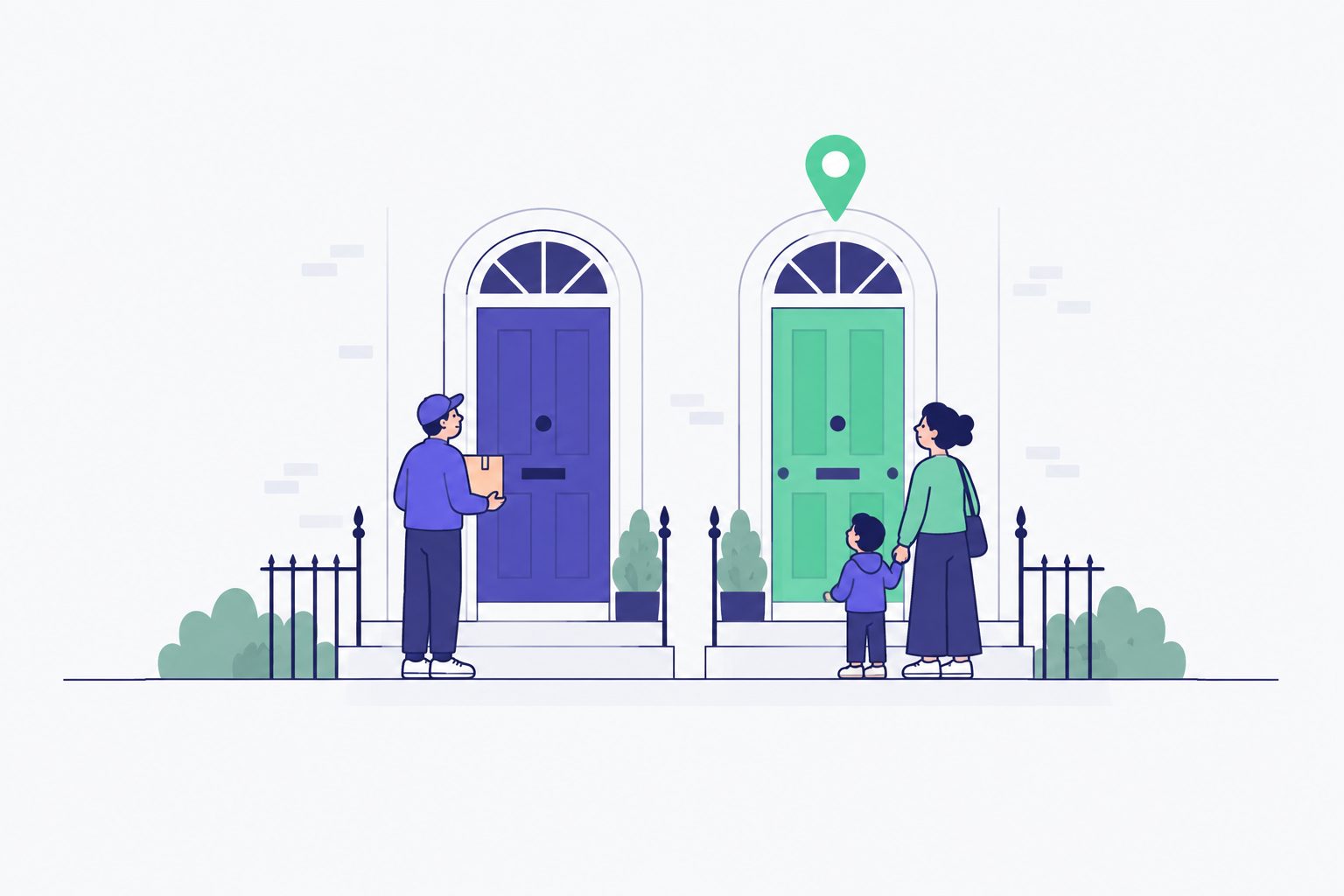
Picture a strip mall with a dance studio, a nail salon, and a physical therapy office sharing one street number and three different suite letters. Geocode the studio's address without the suite, and you can land on the building's front door — technically the right building, practically the wrong business, and a parent walking in on someone else's appointment instead of a ballet class.
I've watched a match like that pass every obvious check. Same street, same number, same city. It looked right at a glance. It just wasn't the door anyone needed.
1. What does "close enough" actually cost?
For a lot of use cases, close enough is fine. You're drawing a dot on a map at city scale, and nobody notices a few meters of drift. But local data gets used for things where the last few meters is the whole point: turn-by-turn directions, a delivery route, a "walk in and check in" experience for a parent dropping off a kid. At that scale, close and right stop being the same thing, and a system that can't tell them apart will confidently send someone to the wrong entrance.
The failure is quiet, too. A slightly wrong pin doesn't throw an error. It just puts someone a short walk from where they meant to be, at a business that has nothing to do with what they were looking for.
2. What should a match check before it commits?
A street number and a city name are a starting point, not a conclusion. A real match should also account for the parts that are easy to drop and easy to get wrong: the suite or unit, which building on a shared lot, whether the listed address is even the entrance the public uses versus a mailing address around back. Two businesses can share a street number and still need two different pins.
When those details are missing or ambiguous, the honest move is to say so — to carry a sense of how confident the match is, rather than rounding an uncertain match up to a precise-looking pin. A vague answer that admits it's vague is more useful than a specific-looking answer that's guessing.
3. What should you ask any location source?
Ask whether a match accounts for unit-level detail, not just the street and number. Ask whether it can tell you it's uncertain rather than always returning a single confident point. And ask what happens with a shared address, like a strip mall or a business park with multiple public entrances, because that's exactly the case where close enough quietly turns into wrong.
If a source can't answer any of that, treat its addresses as a rough area rather than a precise point, and build your product around that honestly instead of trusting a pin that looks more exact than it is.
Why this matters if you build on local data
Anything you build that turns an address into a real-world action, whether it's directions, a delivery, or a "here's where to go" screen, inherits whatever confidence the underlying match actually has. A pin that looks precise but isn't doesn't just cost you accuracy on a map. It costs your user a wrong door, at the exact moment they were counting on you to get it right.
How Tailend helps
We treat a location match as a claim to verify, not a shortcut to round off. A listing's location comes with a sense of how confident that match is, so you can build differently for "we're sure" versus "this is a rough area" instead of treating every address the same.