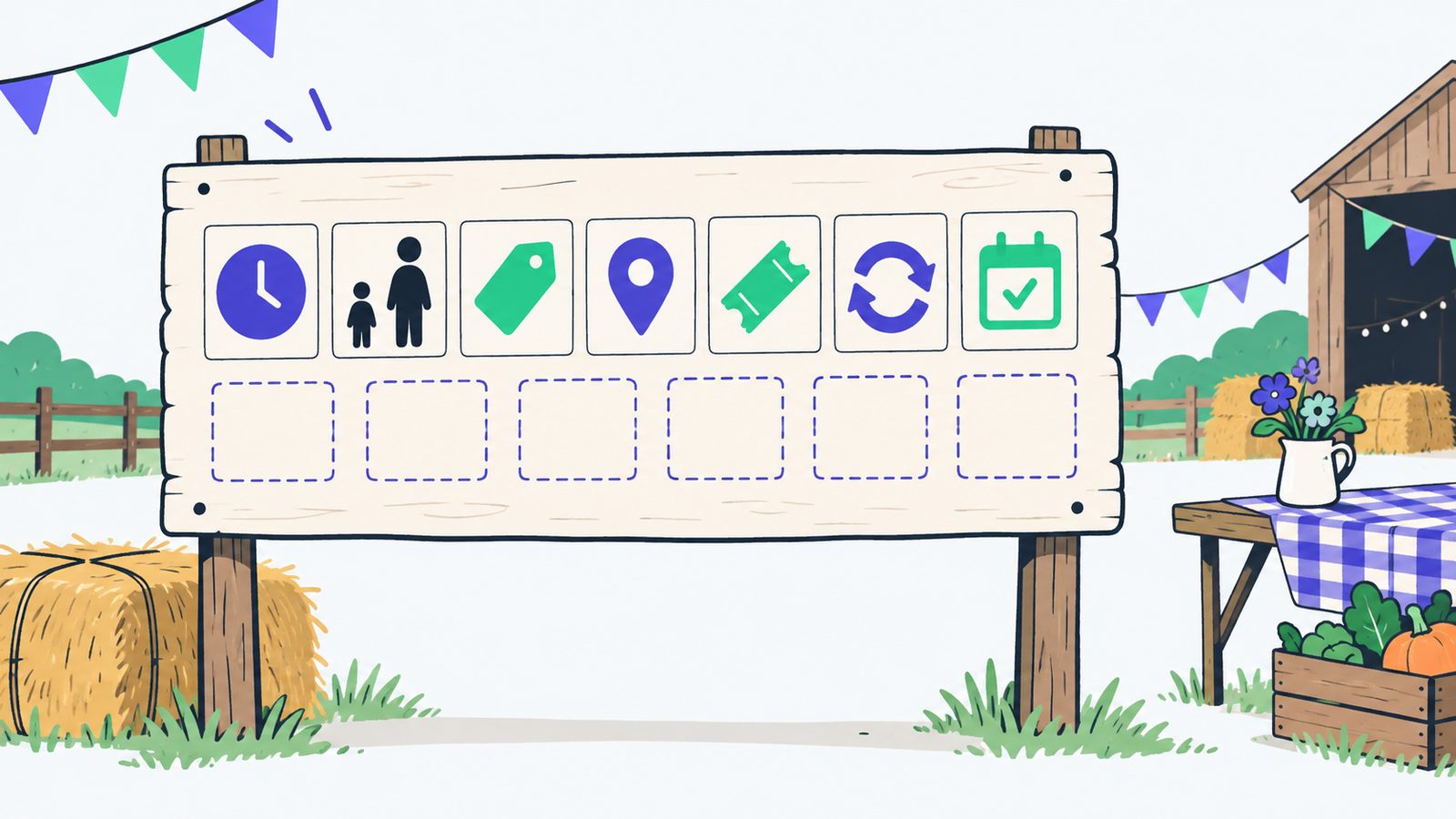
It is Friday evening, and a parent is scrolling for something to do tomorrow afternoon. They land on a farm’s fall festival and try to work out whether it fits around a nap and a birthday party. The announcement says “Fall Festival Saturday!” It does not say when it ends, what it costs, or whether tickets are still available.
That parent has to guess. An assistant trying to answer the same question has to guess too, which usually means a cautious answer or no recommendation at all.
Here are the facts worth looking for first.
1. When does it start, and when does it end?
“Fall Festival Saturday” gives somebody a day, but it cannot help them fit the event around breakfast, a nap, errands, or another appointment. The missing end time is especially awkward. Is this a quick morning stop or an all-afternoon plan?
Write the whole window in one line:
Fall Festival Saturday
Fall Festival · Saturday, 10:00am–3:00pm
The fix is small, but it turns a vague possibility into something a family can plan.
2. What ages is it actually for?
“Fun for kids” is friendly copy. It is also a wide-open question. A parent with a preschooler wants to know whether the activities are a good fit. A parent with an older child wants to know the same thing.
Try saying who the activity suits:
Fun for kids
Pumpkin crafts for ages 4–10
You can still welcome everyone. The point is to give a visitor enough information to recognise whether the event belongs in their weekend.
3. Is it free, or what does it cost?
“Join us!” leaves the family searching for the price, and people often make a decision before they find it. If some parts are free and some are paid, say both. A parent can then decide without opening another page or sending a message.
Join us for a fall afternoon!
Entry is free; pony rides are $5
The important thing is not a particular price. It is the absence of a surprise at the gate.
4. Where exactly should visitors go?
“At the farm” may be perfectly clear to you. It may not be clear to someone visiting for the first time, especially if the property has more than one entrance or sits off a road people do not know.
At the farm
Maple Lane Farm, 24 County Road, red-barn entrance
Give the place its name, street address, and any simple arrival clue that prevents a visitor from circling the property.
5. Do people need to register, and are spots limited?
“RSVP encouraged” is neither a registration instruction nor a capacity answer. It leaves a visitor wondering whether walk-ins are welcome, whether a place is guaranteed, and what to do next.
RSVP encouraged
Register at <page>; spots are limited
If walk-ins are welcome, say that. If registration closes when the room is full, say that too. A clear next step is kinder than making a family interpret a soft hint.
6. Is this a one-time event or does it happen again?
“Craft fair this weekend” can sound like the first of several dates, especially if the event has appeared before. People need to know whether they can come another day or whether this is their only chance.
Craft fair this weekend
One-day craft fair, Saturday only
That one phrase changes how a person weighs the decision. It also keeps an assistant from describing a single occasion as if it were a recurring event.
7. Has the date been confirmed recently?
Seasonal posts have a habit of hanging around. An old announcement can still look current when the next season arrives, even if the date or plans have changed.
Fall Festival — details coming soon
Confirmed this week: Saturday, October 18
You do not need a long update history in the listing. A plain confirmation tells a reader that somebody checked the important fact recently. Only write it if somebody really did, and change it when the date is re-checked.
Why this matters if you run something local
Each missing detail adds a little work for the person deciding whether to come. Enough missing details turn interest into hesitation. They also make it harder for an assistant to repeat your event with confidence, because the safest answer is to leave out what it cannot confirm.
The complete version can fit in one compact listing:
Fall Festival · Saturday, October 18, 10:00am–3:00pm · Ages 4–10 · Free entry · Maple Lane Farm, 24 County Road · Register: <page> · Spots are limited · Confirmed this weekThat is not fancy copy. It is useful copy. A visitor can scan it, compare it with the rest of the afternoon, and decide what to do next. An assistant can describe the same event without filling the gaps with guesses.